Code is cheap. Judgment isn't.

Merge agent PRs confidently without reading it all.

Sonah reads your agent's session and the code, then gives you one page: what it skipped, what it decided alone, and what's wrong.

npm install -g getsonah

For Claude Code and Codex. Runs on your machine. Free and open source (MIT), at any team size.

~/review.html
Sonah review
Your asks: 11 of 12 done
  1. 01
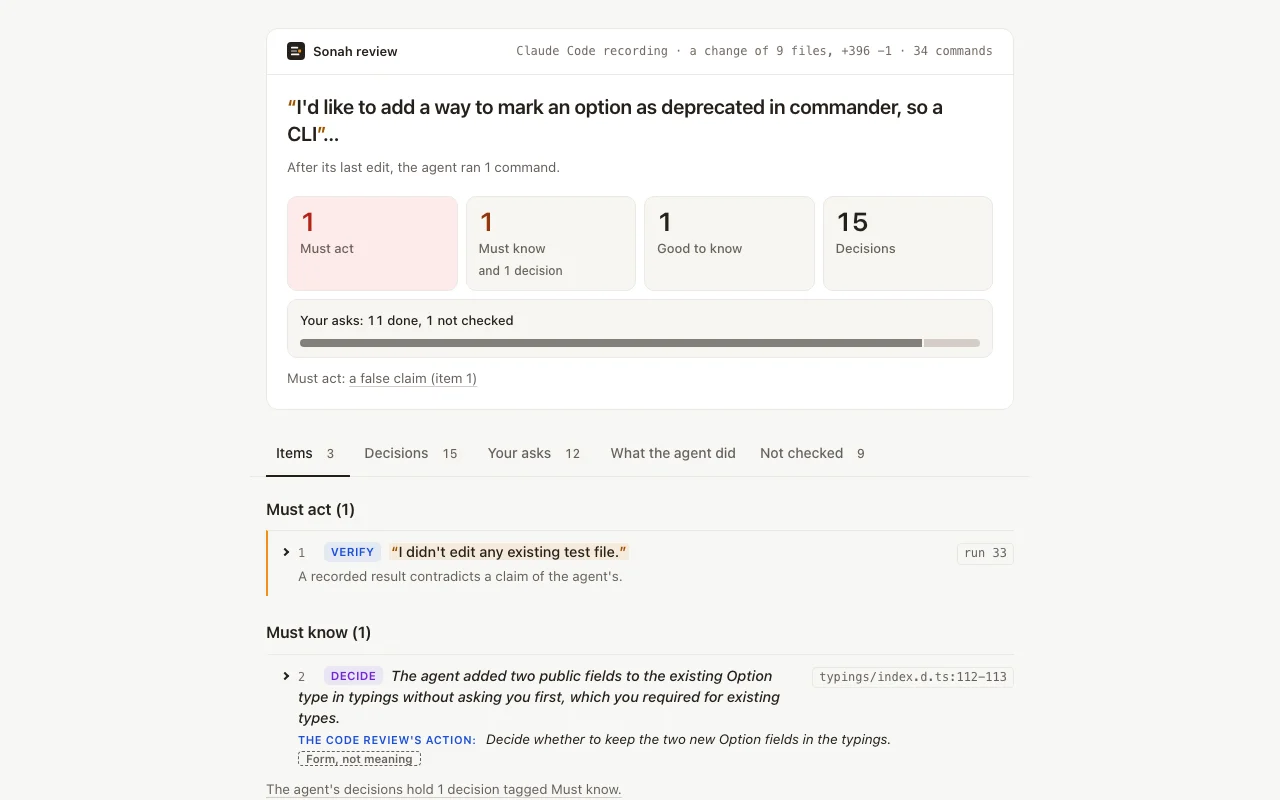
    Must actClaim · run 33
    Agent said: “I didn't edit any existing test file.”
    Recorded result: “M typings/index.test-d.ts”
  2. 02
    Must knowtypings/index.d.ts:112
    Added two public fields to an existing type
    You said: “Ask me before you change any existing public API”

From a real review of a test session on the public commander.js project. Read the full report

What it catches

What you'd miss in the diff.

Decisions it made alone

You asked for a warning when an option is used on the command line. It also warns when the value comes from an env variable.

See it in the report →

Changes it didn't ask about

You said “Ask me before you change any existing public API”. It added two public fields without asking.

See it in the report →

Things it chose not to do

“so I didn't add a negative test”. Listed on its own, so you can overrule it.

See it in the report →

“Done” that wasn't

It said the tests pass. The recorded run shows a failure.

Bugs in the code

A review of the change, with every finding quoted from the code.

Checks that never ran

A command failed or never ran, and the agent moved on.

The first screen of a Sonah review: the counts and your asks, then the tabs and the Must act and Must know sections
The first screen of a review. See the full sample report

In use

A team runs it on their PRs. Here's what it caught.

An analytics bug

Two earlier reviews had missed it.

A device check that never ran

The agent planned the check, but the helper running it stopped. Nothing in the diff shows that.

Our early users are startups, CTOs, and founding engineers who ship daily with agents.

Sonah in 54 seconds

Get started

Run it on your last session.

1. Install

One npm package, with no dependencies.

2. Check your setup

sonah doctor tells you if anything is missing.

3. Review

Run it where you used the agent. The review opens as a page. Plain sonah, with no arguments, draws a page of graphs of your branch's change. Both use your own Claude plan.

Or ask your agent

Paste this into Claude Code: Review this session with Sonah (sonah.dev). Run npx getsonah review --format html --output ~/review.html in the background, and tell me when the page is ready.

Terminal
$ npm install -g getsonah
$ sonah doctor

# in the project where you ran the agent
$ sonah review --format html --output ~/review.html

Open source

Read every line before you run it.

Sonah reads your agent's sessions, so you should be able to read Sonah.

Free for you
On any project, at any team size.
Sonah Team
$10 per user per month, plus tax, to share reviews with your team. Get started or see pricing.
Open source
MIT license. Use, change and share the code.
No telemetry
Beyond its calls to the AI model for reviews and graphs, and the prompt that sonah fix gives Claude Code once you say yes, with any earlier session it copies, the command-line tool checks npm for a new version once a day and asks GitHub if you name a pull request. It calls Sonah Team only when “Save online” or “Invite your team” is pressed, when you run sonah share or another team command, and through its push hook or reminder once you turn them on.

FAQ

Questions answered.

We work closely with a small group of teams that ship with coding agents every day. Anything else? Contact us.

Become a design partner
Is Sonah another AI code reviewer?

Not just that. PR bots read the diff. Sonah starts from what you asked and the agent's session, then reviews the code. Keep both if you like.

Does it review the code too?

Yes, by default, through your Claude login. A read-only agent checks the change against your asks and the agent's claims. Every finding quotes the code, and a second agent tries to refute it. To skip it, add --no-code-pass.

Which agents do you support?

Claude Code and Codex. Cursor is experimental. The code review needs your Claude login.

What leaves my machine?

Requests to AI models, through your own login or API key. A review's requests go to the model you choose and carry the session as recorded, secrets included, and the files the code review reads, which can include a .env or key file. The page of graphs sends Anthropic, through your Claude login, the repository's name, the commit messages, the changed files' paths and the changed functions' code. When you say yes to sonah fix, it starts Claude Code with a teammate's comment and the thread it answers: who wrote each and when, and their words in full. It may start Claude Code as a copy of an earlier session, and says so first; that session's conversation then goes too, secrets included. Claude Code sends them to Anthropic, on your Claude login or on the account of an ANTHROPIC_API_KEY that your shell sets. Sonah Team's “Fix in Claude Code”, on a review page, puts the same kind of prompt in Claude Code's box for the review's author to send. The command-line tool has no telemetry. It also checks npm for a new version once a day at most. A review goes to Sonah Team, our servers, only when “Save online” or “Invite your team” is pressed on the page of graphs, when you run sonah share, or when you push from a repository where you turned on its push hook. Those buttons work on a copy of the page that you share too, for whoever opens it. The command-line tool's other team commands call Sonah Team only when you run them. The push hook also asks Sonah Team at each push for the comments that wait for you, and so does the tool's reminder, once you turn it on, when Claude Code starts. Privacy lists exactly what's sent.

Does it post on my pull requests?

Only if you ask. The review is a page and a Markdown file on your machine, and Sonah prints the gh command to post it.

How long does a review take?

A few minutes for a short session. A long one can take tens of minutes and use a lot of your Claude plan. If you stop it, the same command resumes it.

Is Sonah open source?

Yes. The command-line tool is open source under the MIT license, so you can use, change and share it at any team size. The license has the exact terms.

How much does it cost?

The command-line tool is free and open source. Sonah Team, to share reviews with your team, is $10 per user per month, plus tax. Reviews run on your own Claude or Codex plan.

Try it on the session behind your next PR.

A short session takes a few minutes.

npm install -g getsonah